
Aequanimitas
Letter #115

Later this month, Gram and I will be driving to Baltimore so that I can join former classmates to celebrate the 50thanniversary of our graduation from medical school. That my classmates and I have all reached this milepost so quickly is amazing to me. It seems that only yesterday I was a young, busy faculty member, observing my “elder” colleagues being honored at annual commencements for their many years of service. For me, planning for this reunion has triggered many thoughts about my own education and training to become a physician, and about how those who came generations before me influenced my development.
The first generation of physicians at the medical school I attended changed the trajectory of medical education in the United States. They introduced a curriculum based upon scientific advances rather than only through lectures about existing methods of practice. Scientific research, modeled after German universities, was adopted at my school, and it was to become the standard for medical school faculty in North America, creating generations of “clinician-scientists” whose work was grounded in research and patient care. The medical school that I graduated from – Johns Hopkins – was the first to admit women on an equal basis with men – starting with its very first class 133 years ago. In subsequent years, the hospital was the first to use sterile gloves during surgery, to offer renal dialysis, and to develop cardiopulmonary resuscitation.[1]
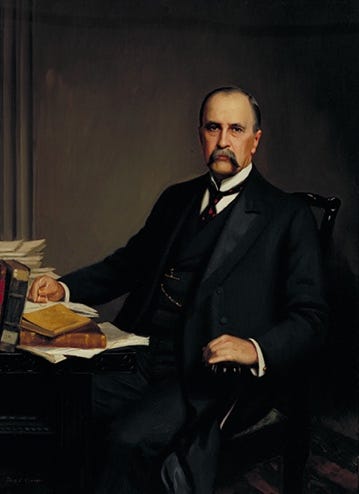
In 1893, William Osler was recruited as the founding physician-in-chief and professor of medicine at the medical school I attended. He introduced patient-based, bedside clinical instruction, as well as the first residency program for specialty training of physicians. He was respected as a superb diagnostician and teacher and as a compassionate physician. His very presence and kindness brought healing.[2] He also expected commitment from those who studied to become physicians. One myth that I heard as a student was that he encouraged his trainees to defer marriage until age 40 so that they could fully focus on their medical training.[3] But he did require those physicians who trained with him after graduating from medical school to live in the hospital. And for this reason, physicians today at this stage of their training are still called “residents” or “house officers”.
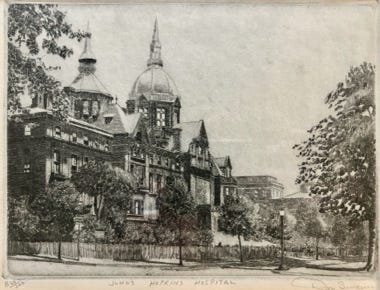
The greatest value that Dr. Osler bequeathed to the scholarly atmosphere of the medical school, was one that I found important to embrace 80 years later, when I studied there: equanimity. In a series of lectures, collectively given the name “Aequanimitas”, he spoke about the importance of “coolness and presence of mind under all circumstances, calmness amid storm, clearness of judgment in moments of grave peril. . .”[4]
This was not to be confused with callousness or apathy, but something to be balanced with compassion in order that emotional responses are neither excessive nor absent, and conducive to calm judgment. In speaking to graduating medical students, he once concluded:
It has been said that ‘in patience ye shall win your souls,’ and what is this patience but an equanimity which enables you to rise superior to the trials of life? Sowing as you shall do beside all waters, I can but wish that you may reap the promised blessings of quietness and of assurance forever, until “Within this life, Though lifted o’er its strife;” you may, in the growing winters, glean a little of that wisdom which is pure, peaceable, gentle, full of mercy and good fruits, without partiality and without hypocrisy.4
William Osler was the 8th child born in rural Ontario to Welsh parents who had immigrated to Canada. His mother was devoutly religious and his father was an Anglican missionary who preached in the northern wilderness. When growing up, Dr. Osler loved the countryside and read extensively. His interests gravitated toward medicine as he learned more about recent scientific advances; perhaps too it was related to the death of a two-year-old sister. He obtained his M.D. degree from McGill University in Montreal, but subsequently studied in London, Berlin and Vienna before returning to McGill, where he began his teaching career in academic medicine.
I don’t know whether it is because of genetics, training or both, but I have largely been able to maintain a sense of equanimity throughout my life. Perhaps this is because I am able to look beyond the problem at hand, certain that problems find resolution and that people find acceptance. Perhaps I have received the promised blessings of quietness and assurance.
Worry – especially as a parent or grandparent – is certainly not something that I am exempted from. But I somehow find a way through the thickets of the unknown and the dark frightening valleys of life. The phrase that always echoes in my mind is this: “All shall be well, and all manner of things shall be well.”[6] That is a statement of outcome – a promise that has proven to be true no matter what circumstances may arise. It is not a denial or a cliche.
This promise, which I have heard in many variations over the years, was received by Julian of Norwich, England. After recovering from her deathbed experience, she wrote about this in 1373.[7] Julian – like us, but long before us – knew that there is pain, suffering, and other challenges in life. But these are details of the moment and not the final outcome. She believed in God’s inexhaustible love and ultimate reconciliation with mankind, replacing hopeful optimism with deep equanimity.

I am encouraged by the synergy that I have found between William Osler and Julian of Norwich. Osler approached the deep issues of life from a professional and scientific perspective and Julian approached them from a mystical and divine perspective.
Equanimity, which some people seek throughout their lives, re-frames the fear that many people face in times of uncertainty. While none of us know what will occur in the midst of crisis, we can know that overwhelming threats of the present lose their power once we learn to look beyond them. This has allowed me, as a physician and as a person, to remain calm during illness, loss, or chaos. It provides strength to be patient, waiting for the outcome rather than pursuing comfort through false reassurance.
Equanimity stabilizes and focuses our attention, allowing us to faithfully take the next appropriate step without anxiously grasping for control of the entire situation. The calmness of Osler comes from training, character and a disciplined mind; that of Julian comes from surrender to the providence and love of a personal God. Both are calm in the midst of catastrophe. We each have important roles and responsibilities in a given circumstance, which we can best fulfill by fully attending to them rather than perseverating about the possible outcomes.
And equanimity creates space for a compassionate presence. If “all manner of things shall be well”, we are released from the need to immediately fix everything. This allows us to show understanding and steadfastness during times of suffering, pain or loss.
For me personally, Osler shapes the form of my equanimity and Julian shapes the content. I strive to be even-tempered, clear thinking and reliable under pressure, while I also trust that each patient’s story – and each one of our stories – is part of a human drama that is larger than we are able to see or understand in the midst of what is going on with us or around us.
Equanimity is the measure of my genuine conviction that “all shall be well”. I cannot satisfactorily define the nature of God to whom I entrust these ultimate outcomes. This is a task that has defied philosophers, theologians, and all humans for centuries, leaving me to believe that those who are certain in their knowledge are likely too limited in their understanding of the one who reconciles all things.
Opa
[1] https://www.hopkinsmedicine.org/about/history
[2] https://bcmj.org/sites/default/files/BCMJ_48_Vol9_Premise.pdf
[3] https://litfl.com/lessons-from-osler-001/
[4] https://blogs.library.mcgill.ca/osler-library/aequanimitas/
[5] https://medicalarchives.jhmi.edu/portrait/osler-william/
[6] https://www.cbeinternational.org/resource/all-shall-be-well-julian-of-norwich-medieval-mother-of-theology/ and https://www.centreforoptimism.com/all-shall-be-well-and-all-shall-be-well-and-all-manner-of-thing-shall-be-well
[7] Julian of Norwich, Revelations of Divine Love, translated by Barry Windeatt, Oxford University Press, 2015. See also: https://historytheinterestingbits.com/2020/04/05/julian-of-norwich-all-shall-be-well/