
Identity and Purpose
Letter #87

As I was writing last week’s letter, I began thinking again about what it felt like to be a student, which I was for many years. I wasn’t thinking about the logistics or routines of going to school as much as I was pondering about a bigger issue in life: Why am I alive? What am I here for? What is my purpose? How does school equip me for both the present and the future?
To be honest, none of these issues crossed my mind in my first four or five years of school, when I viewed it as an adventure and was content to be meeting new people and learning new things. I accepted all my classmates as equals, regardless of whether they were different from others in size, ability, clothes or personality. I accepted whatever idiosyncracies they might have had as part of who they were, much like I naively accepted those of my parents as being typical of all parents. I really didn’t ask myself what was normal; I accepted everybody as being normal, because I thought that there was considerable variation in what “normal” could be.
There were exceptions: In the 4th grade, when we practiced handwriting and looked at everyone’s work via the overhead projector, I thought that Cathy S. had the best penmanship in the class. But other classmates had other strengths, and I was content to accept our differences.
My thinking began to change in grades 5 through 8 as I became more observant and perhaps discerning, although I didn’t clearly know what my norms were based on. Perhaps they came from popular television shows like Father Knows Best, Leave It to Beaver or My Three Sons.[1] At that time, I might have considered one boy to be too tall, another too small; I might have thought one girl to be very pretty and another not as much; I might have observed one classmate to be an excellent athlete, and another to be a painfully slow runner. Neither extreme struck me as good or bad, just as part of who they were.
In high school, however, I began to judge myself in comparison to others – typically to those who excelled in one way or another. I wasn’t as tall as ___, I wasn’t a muscular as ___, I couldn’t score as high on exams as ___, I couldn’t run as fast as ___, I couldn’t walk down the hallway on my hands like ___, I couldn’t get an encouraging response when asking a girl for a date like ___. I began to compile a mental list of my deficiencies, and was no longer satisfied with who I was.
This led to a personal sense of inferiority. I accepted that I was even-tempered, friendly and hard-working. However, in my mind I had focused instead on the best qualities from each of my classmates and created a model of who I aspired to be – who I thought I needed to be. I was in my late 20’s and early 30’s before this fog of inferiority finally lifted.
I didn’t directly address the issue of who I needed to be – and “needed to” for what purpose? I was instead stuck on considering who I wanted to be - which is best translated as being more like the people I most admired.
With this as background, I want to write about two issues: the first relates to the curse of making comparisons, and the second concerns the pursuit of finding our purpose.
Gram and I both grew up in the early years of advertising. We saw messages in magazines and on billboards along the highways; we heard advertisements on radio and, to a lesser degree, on television. Many advertising jingles and songs are still stuck in our brains. Many of these focused on glamourous or prosperous people and what clothes, products, or services we (or our parents) needed to purchase in order to be more like them. The advertising industry fed the self-doubts and insecurities that I was internalizing, without being aware of it.
Today there is a bigger, louder, and never-ending cacophony of advertisements. They interrupt, if not dominate, radio programs, television shows, and free streaming music and video. In addition, social media today is driven by professional “influencers” who promote their own preferences for products, travel, restaurants, and beliefs that complement commercial advertisements. The common message is that no one has enough, that only the select are good enough, and that everybody else needs something more to make themselves better (or at least to momentarily feel better about themselves).
This is the curse of comparisons – we compare ourselves to others who we often don’t even know but may admire, and – in doing so – we diminish the true value of ourselves. We accept the judgement of others (people who may not even know us) in declaring us deficient. However, we do not have to be perfect to be loved or accepted. We do have to be “real”, and by that I mean honest. We have to be ourselves . . . with an accepting awareness of our strengths AND weaknesses. We must be, or strive to become, who we truly are. It will not work to be somebody you admire, or somebody that others think you should be, or somebody who will just make your family or friends proud.
This leads to my second issue, the pursuit of purpose. This takes us back to the questions that I started with: Why am I alive? What am I here for? What is my purpose? In some parts of the world, children are still conceived to provide labor in supporting the financial needs of the family or to work on the family farm. In some cultures, children are brought into the world so that they can take care of their parents when the parents become old. These examples are not predominant in our society today.
So why are you here? Is there something more than a biological event that gave you a start in this world? Do you know your purpose? Are you searching for a purpose? Today, when I ask others about this, many young people state that their goal is to get rich . . . quickly! This is a grander vision than just meeting basic needs; it seems to be a path to leisure or luxury. Is this, then, the purpose of living: to work hard in order to have an abundance of free time or of pleasures? We live in a fast-paced society in which we are encouraged to be consumers. Is creating wealth or consuming goods the purpose of our lives? Is the purpose of living for oneself only?
In the 1980’s – during the “greed is good era” - I remember seeing various bumper stickers and decals that said: “He who dies with the most toys wins.” This used humor to capture a purpose for life that amounted to no more than a materialistic acquisition of things.[2] This was not a perspective that Gram or I endorsed, even though we recognized the importance of working hard to support those whom we love.
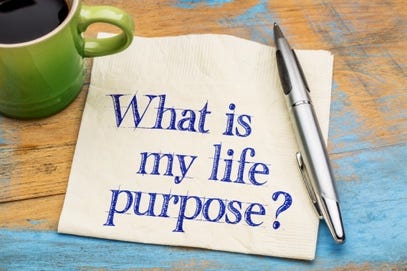
Purpose is what gives us a reason to survive, to persevere during difficult times and to pursue our goals despite adversity or disappointment. It is more than just having a goal to achieve, although it is something that provides the reason for and direction to your goals. It has to be something that is personally meaningful to you, and not necessarily to anybody else. And it has to be something to which you will sustain a commitment, regardless of circumstances or opinions swirling about you.
Everyone must find their own reason for living – one that meets their physical, emotional and spiritual needs. It is not a task for me – or anybody else – to define for you. It is something that you must discover, develop, and (if necessary) modify for yourself. But purpose is woven together with identity. You cannot develop a sustainable purpose without discovering and accepting your own, true identity. In many ways, these qualities develop and grow together.
In writing about living in our unpredictable world, Brian Klass, who is a professor of global politics, recently wrote: “We control nothing, but we influence everything.”[3] To me, that brief statement seems important when thinking about personal identity and purpose. It is a reminder that, no matter who we are or the status we achieve, the decisions we make every day – in learning about and accepting ourselves, in establishing and pursuing our goals, and in knowing and fulfilling our purpose – have an impact on people around us, whether we are aware of that impact or not.
Each of us have been gifted with a unique panoply of interests, abilities and limitations. We need to understand what those are. The Hebrew poet king David once wrote a Psalm expressing his gratitude that he was “fearfully and wonderfully made”.[4] Gram has often reminded each of our children – and each of you grandchildren – that this is equally true for you.
Take time to contemplate where you focus your attention and where you find meaning in life. Consider how you respond to limits imposed by your own abilities, by circumstances around you, or by failures that you have experienced. Take time to connect with nature, of which we are a part and for which we are stewards. What sustains you through these rigors of life? Make an effort to know people who live different lives and have different families and cultures – whether in your neighborhood or around the world. Some of these efforts may help guide you in learning who you are, in becoming the best version of yourself, and in finding the purpose that will sustain you.
Opa
[1] Father Knows Best (1954 – 1960) starred Robert Young and Jane Wyatt as parents. Leave It to Beaver (1957-1963) was about a young boy and his teenage brother growing up, with their firm-but-loving parents played by Hugh Beaumont and Barbara Billingsley). And My Three Sons (1960 – 1972) starred Fred MacMacMurray as a widowed father and aeronautical engineer.
[2] https://www.stgeorgeutah.com/opinion/of-grave-concern-he-who-dies-with-the-most-toys-may-win-but-he-s/article_51b79496-e8ad-58e5-8ba3-0ca846a90671.html#
[3] Brian Klass, Fluke: Chance, Chaos, and Why Everything We Do Matters, 2024.
[4] Psalm 139:14, translated with a slightly different emphasis on awe or complexity in each version, but always reflecting his self-awareness and deep gratitude.