
O Tannenbaum
Letter #99

Both Gram and I have a similar childhood memory of helping decorate our family Christmas trees with tinsel. Thrilling as it was when the fresh tree was brought into the house, the excitement faded after the ornaments were hung and we started spending a long time placing the tinsel “icicles” on the tree. Tinsel consisted of long, thin strands of shiny foil that sparkled when reflecting light. Once the tree was fully covered, the tinsel created a magical brilliance, but it took what seemed like eternity to place a large number of them – one strand at a time – on each branch. After an hour or so, it was tempting to hang clumps rather than single strands or even throw a bunch of the tinsel onto the tree and move on to more exciting activities. But both Gram and I had mothers who were meticulous and wanted each tree to look like it had an even covering of snow that had melted into frozen icicles. Even the Christmas music that our parents played on the stereo failed to keep our spirits from melting.

Christmas tinsel dates back to the early 1600’s in Germany, when fine silver strips were designed to mimic icicles and used to reflect the light of candles attached to the trees. Initially affordable only by the wealthy, the use of tinsel became more popular when a combination of tin and lead was used in the manufacturing. These were the strips that Gram and I handled – by the hundreds. Before any of our children were born, however, the toxicity of lead had been recognized, and it was removed from tinsel (as well as from lead-based paint and leaded gasoline). Tinsel today is safer – made from PVC with a shiny finish – but, because it is lighter, it is even more tedious to put on trees!
By the time I was in college, I had learned that a safer and more colorful decoration for Christmas trees was red and white garland made with cranberries and popcorn. I remember one year inviting friends to a holiday party; we visited while stringing garland, hoping not to squish the cranberries or break the popcorn as we pushed needle and thread through each. It was a beautiful decoration, but no one had any enthusiasm for making this a yearly tradition.
At my suggestion (since Gram had never done this before), we decided to make the cranberry-popcorn garland for our first Christmas on the Hopi Reservation. A close friend of ours, a pharmacist from Seattle, Washington, who worked with us at the hospital, helped us to make the garland. She was patient, but agreed with Gram that the project was not as much fun as it had sounded.

Our time on the Reservation also included what was our most exciting hunt for a live Christmas tree. We were invited by Jim and Sally Barrett to look for trees to cut down and bring home. We lived hours away from the nearest possible vendor of harvested evergreens, so we went searching on the closest mesa. Jim owned a huge, 30-year-old World War II vintage ambulance – which served for him as an all-season, all-terrain vehicle. After a recent snow, he and Sally gathered us and our 15-mo-old daughter and we set out with enthusiasm and saws. (Yes, in the winter it DID snow in the high plateaus and mountains of Arizona. Keams Canyon has an elevation a little over 6400 feet.)
We began driving up the Canyon, past the original, now-vacant Indian Health Service Hospital where Jim and I both worked. The canyon was named for Thomas Keam, an Englishman who opened a trading post among the Hopi and Navajo Indians in 1876.[1] As the pavement ended just beyond St. Joseph Mission, a Catholic Church, it continued as a rocky, dirt road that wound through the canyon and up onto the mesa from which the canyon was carved. The temperature had finally risen above freezing, so – even though snow was visible on the ground – the road became muddy and the massive ambulance fish-tailed most of the way.
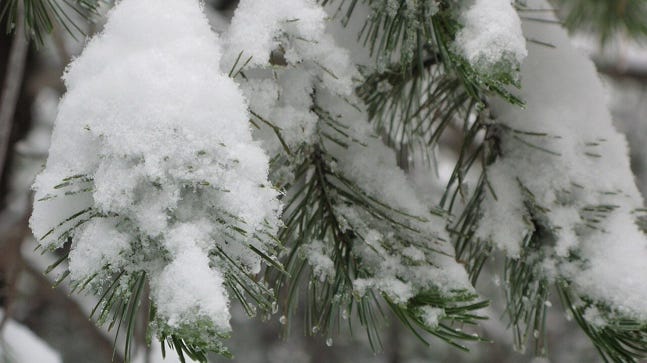
After multiple stops, Jim and I found our ideal trees and together cut them down, carried them to the ambulance and loaded them up, with the tops of the trees hanging out the back of the truck. The ideal sunny weather at the beginning of our trip deteriorated, and on the way back we encountered a snowstorm with more wind and intense cold. Our ultimate, safe arrival home was definitely a hot chocolate moment!
For Gram and I, throughout all of our adventures and misadventures each year, the evergreen Christmas tree has always been a reminder of God’s enduring and unchanging faithfulness – even during spiritual “winters” of our lives. Since 723 AD[2] the evergreen tree has served as a symbol of creation itself standing in worship of its Creator. Even the 16thcentury Silesian folk song Ach Tannenbaum praises the evergreen for its qualities of faithfulness and dependability.[3]Regardless of how we choose it or display it, the Christmas tree is a gentle reminder that we too should demonstrate those same qualities.
Opa
[1] Trading post history of Keams Canyon at: https://bit.ly/4p3u64j
[2] https://www.earlychristians.org/the-origins-of-christmas-tree/
[3] https://www.thoughtco.com/german-versions-of-o-tannenbaum-4066932