
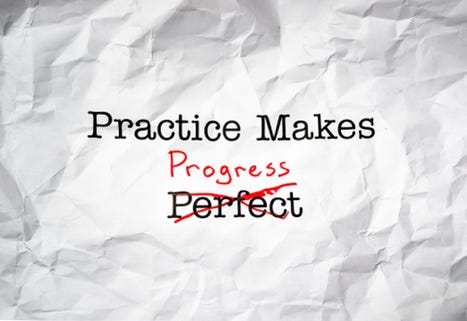
Practice Makes Perfect
Letter #113

Reading science fiction has been a gratifying escape for me since I was a child, allowing me to explore new and untested ideas about future times, distant places or different cultures as imagined in the author’s mind. As I explained in Catalogue Kids (Letter #6), I grew up in the same town where Robert Heinlein – the “grandfather” of American science fiction – lived and wrote; I still have my hardback copies of Space Cadet (1948), Between Planets (1951) and Citizen of the Galaxy (1957), saving them for grandchildren or great-grandchildren who might enjoy reading these books someday.
Within the genre of science fiction, there are books that are simply entertaining and there are some that introduce brilliant concepts, opening the reader’s mind to new ideas or possibilities not previously imagined. Years ago, I found a book that falls into both categories. It is based on a conceptual premise that has occasionally echoed through my mind since I first read it. It was written by David Brin, who completed his undergraduate and doctoral studies in astronomy, but has subsequently spent most of his effort as a science fiction writer, exploring the impact of possible changes or advances in scientific or technical knowledge.
The Practice Effect was published in 1984.[1] Re-reading Brin’s book four decades later has allowed me to winnow what seems valuable. I’d like to share this with you.
With unintended prescience and irony, Brin began the story by relegating the protagonist, Dennis Nuel, to “a small AI program mandated by an unbreakable old endowment – even though it had been proven back in 2024 that true artificial intelligence was a dead-end field.” (p. 7) He was rescued from this fate by being offered an opportunity to repair a device, mostly of his own creation, that allowed, for the first time, travel between worlds. However, the return mechanism through the portal unexpectedly stopped working, necessitating a repair on the destination side.
Understanding the possibility of being stranded, Dennis considered this risk no worse than being stuck working on AI. He therefore stepped into the new world, but – as he did so – he received an enigmatic warning from a jealous colleague, about the laws of physics perhaps being different there.

As Dennis emerged from the portal, he cautiously explored a new world that in many ways resembled his own – similar vegetation, animals and even people, whom he believed to be in the “caveman” stage of development. (p. 81) Unfortunately, he found that these inhabitants had chopped key elements of the receiving portal into pieces that were organized and left on the ground.
The primitive nature of the agrarian society that Dennis encountered seemed inconsistent with the tools he saw that were of extraordinarily fine quality. He was amazed to see a frictionless road on which wheel-less carts were effortlessly pulled by animals. As he approached the nearest city, he encountered people wearing beautiful, fine clothes – unlike the crude, homespun attire of folks in the countryside where he entered this world. He was surprised to learn that the well-dressed individuals were actually prisoners, whose job was to wear the clothes.
Although Dennis understood the words that these people used, it took him a long time to understand what they meant. The key word in their language and lives was “practice”, which to them meant repetitive use, by which things became more efficient or refined. It was a distressing realization to Dennis that – in this world – the 2nd Law of Thermodynamics operated in reverse.[2] In the new world, “wear and tear” was no longer the physical manifestation of entropy increasing (and available energy decreasing). “Use and improve” was the new physical manifestation of entropy decreasing, but only through the contribution of human energy.
Every inanimate object improved with use. A crude tool became a refined one. With “practice”, a primitive road became frictionless when frequently travelled; houses became more refined the longer they were occupied; and defensive walls became stronger when attacked. The items that were of the finest quality were those which were the oldest and had benefitted from the most “practice”.
The corollary to this inversion of physics was that inanimate objects had to be used in order to be improved or even to retain their usefulness. Clothes that were not worn reverted to rags; swords that were not “practiced” reverted to sticks. It was for this reason that people became slaves to the wealthy, whose clothes in a wardrobe had to be constantly worn by someone to remain worthy of being occasionally worn by the owner. In fact, the entire upper class of the society required their prisoners or slaves to maintain or improve their most valuable possessions . . . by constantly using them.
This had profound social implications. “The chief commodity here was the human man-hour,” Dennis observed. Most people were so busy using things of the wealthy that they neglected the things that they themselves owned. “In relaxing (a man) practiced his master’s chair; in eating he practiced his mistress’s spare dinnerware. He couldn’t save to buy his freedom, because anything saved away had to be maintained, or face decay!” (p.96)
This was a society in which technology never developed. “It didn’t pay to specialize. Wherever a person could practice three or four items at once, it paid. The niceties of concentration seemed less important than keeping as many things busy as possible all the time.” (p.97) There was an inevitable futility to this human factory: its interruption negated what had been achieved. On the other hand, inanimate objects – like pieces of furniture – grew older and also better through repeated use, and worked their way up the socioeconomic ladder. There was upward mobility for things, but not for people. (p. 100)
There was a state religion that legitimized this social structure. It was predicated on the belief that man himself could not be improved. “It is only the inanimate that may, with man’s intervention, be practiced to perfection,” said a high priest. (p.113) Belief that living things also had potential to improve, he added, was a remnant that survived only among primitive tribes who lived beyond the city. The name that author David Brin gave to this world was “Tatir” – in Hebrew, the future tense of a verb that means “to permit” or “to allow”.
In ancient days, among the primitive tribes of Tatar, it was believed that life had the potential to be made better, and that inanimate tools did not. (p. 135). Dennis pondered this and thought about how Earth itself seemed a strange place: “Cause and effect seemed so straightforward there, yet entropy always seemed to be conspiring to get you!” (p. 184) David Brin’s story meanders through discovery, adventure, conflict, war, romance, and some convoluted bioengineering, but ends up revealing Tatir as the future Earth.

I found this book to be unsettling when I read it forty years ago and also when I recently read it again. On one level, The Practice Effect is a story about the morality of ownership. How much do we really need? How much can we realistically use? What is the price we pay for surrounding ourselves with more inanimate objects than we have the time to appreciate?
At a more frightening level, the book could be considered a commentary on the social impact of economic societies. How much is necessary to acquire in order to maintain a person’s desired social status? Why is this even important to us? How much of the time that we spend in building an inventory of things would be more wisely spent on being creative or developing relationships with others? And, as we acquire more, what is the cost to other members of our society? How are we economically “enslaving” others when we thoughtlessly embrace consumerism?
These questions remind me of a “battle” between bumper stickers on cars that Gram and I observed years ago. One announced: “He who dies with the most toys wins!” The other advised: “Live simply, so that others may simply live.”
At this moment in the 21st Century, when the titans of our economy are committing unprecedented investments of capital and natural resources into data centers and semiconductors for enhancement of artificial intelligence (AI), how will we manage to navigate the relationship between intelligent inanimate objects and living people? Will there be a dead-end for AI, as David Brin predicted four decades ago, or will the dead-end instead be for humanity?[3]
My purpose in writing about this book is not to strongly recommend it or to pass along any anxiety that I may have about the future; there has always been enough for each generation.[4] Instead, my goal is to encourage you to read widely, to “cast your net” in all directions, in order to explore many different ways to think about our individual and collective humanity, our technology, and the results of our choices and actions. We must always be mindful of the wake that we leave behind for future generations.
Opa
[1] Coincidently, Nineteen Eight-Four (1984) is also the title of George Orwell’s well-known and last book, which was published in 1949. It describes a dystopian future characterized by totalitarianism and perpetual war. See: https://en.wikipedia.org/wiki/Nineteen_Eighty-Four
[2] The 2nd law of thermodynamics states that heat naturally flows from hotter bodies to colder ones. This means that, as energy is transferred it is not fully conserved and that things tend to “run down”. Entropy is a measure of how much available energy is spread out, dispersed or useless. See: https://www.ebsco.com/research-starters/history/clausius-and-second-law-thermodynamics
[3] Greg Satell, “Why you should not become an AI expert.” Fast Company, 3/18/2026
[4] Matthew 6:24 (NIV): “Therefore do not worry about tomorrow, for tomorrow will worry about itself. Each day has enough trouble of its own.”
I love high concept science fiction. I'm definitely adding The Practice Effect to my reading list.