
Red Scare Redux - Part 1
Letter #128

I have always had an interest in history and, as I have likely mentioned before, I started college as an International Relations major. As a freshman, I joined the staff of my school’s student journal, called The Vector. I was one of a dozen students who worked on the journal under the guidance of Robert Roy, the Dean of Engineering Science. I contributed an article to the December, 1969 issue.
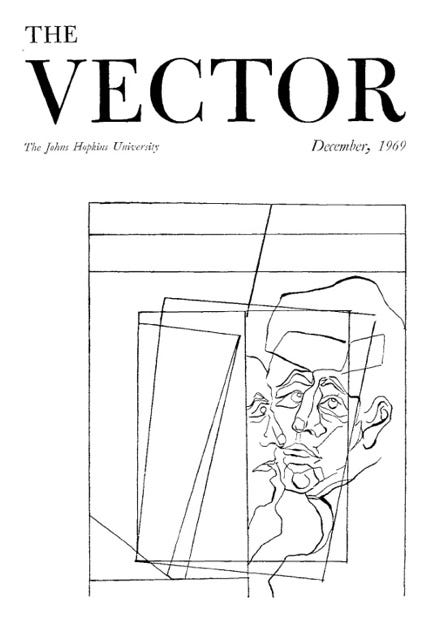
The article still seems to have relevance today, even though a hundred or so years have passed since the events I wrote about took place. This week – rather than writing something new – I will share with you what I wrote as an 18-year-old starting college. This article will be in two parts, with the second half to be posted next week. The words that follow are the same ones published 57 years ago; they’ve not been “cleaned up” to reflect my current writing style, nor have they been improved with editing by Gram. I have, however, added footnotes and relevant illustrations where I think they would be helpful.
* * * * * *
On New Year’s Day, 1920, thousands of Americans were arrested by the United States Government in an effort to “sweep the nation clean of alien filth.”
At a victory pageant in the District of Columbia, May 6, 1919, a man refused to rise for the playing of “The Star Spangled Banner”. When the national anthem was finished, an enraged sailor fired three shots into the man’s back. When he fell, the crowd cheered.
Earlier that year a jury in Hammond, Indiana, took two minutes to acquit the assassin of an alien who yelled, “To hell with the United States.”
The Great Red Scare was the result of a fanatical Americanism which pervaded our society during the years 1919-1920. This phenomenon remains important because it provides an example of what happens to a democratic nation and its people when faith and reason are supplanted with fear.[1],[2]
The atmosphere in which this phenomenon occurred resembles the atmosphere in which the Know-Nothings[3]and McCarthyites[4] came to power. The American public in 1919, as well as in 1853 and 1952 sought to punish disloyalty, revive patriotism, and keep the government in the hands of loyal Americans. Whether this atmosphere is recurrent in nature and whether it exists in today’s society can only be decided by the individual who is aware of the changing moods and conditions in each of these eras.
After the First World War the people of the United States wished to return to “normalcy”. But the life before the war was gone, and new forces, responsibilities, and events prevented the possibility of escaping into the future through the past. The nation in 1919 soon found itself frustrated because it sought to fulfill its hopes by moving backward.
The Red Scare for all practical purposes began after the signing of the Armistice on November 11, 1918. The ensuing demobilization, which flooded the job market with four million men, forced the populace to face the problems of reconversion[5] and spiraling prices. By 1919 the purchasing power of the 1913 dollar had shrunk 55%, while the cost of living had increased 99%.[6] Most Americans considered inflation the cause of labor unrest, but the growing unrest was more probably a result of the flooded job market. The public in 1919, as today and in the era of McCarthy, sought one source from which all hardships stemmed and chose (with little justification) one cause for many problems.
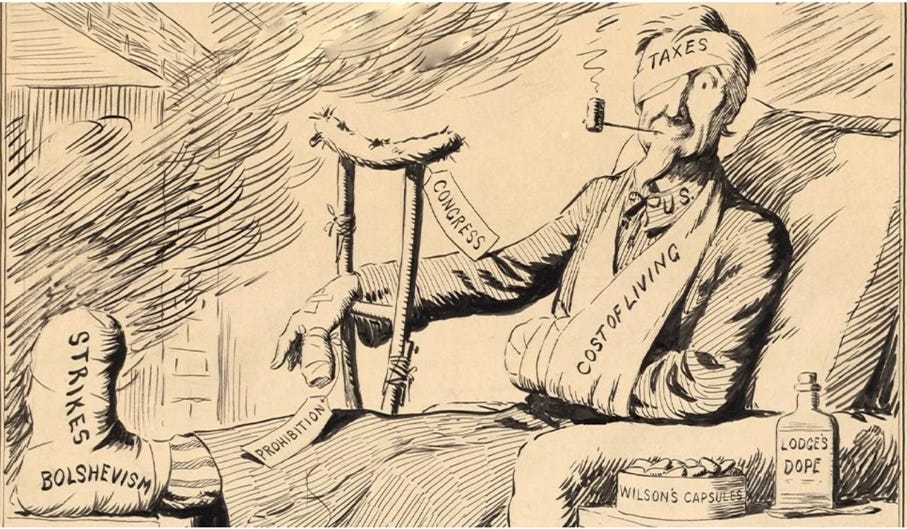
The dislocation[7] at the end of the war, which had such great effects on the 1919 economic scene, also had serious repercussions in politics. In the preceding November, the American people elected a Republican majority to both houses of Congress to serve under a Democratic President. The actions of this Congress made a significant contribution to the climate in America. Congress, for example, abruptly ended wartime reforms before a new peacetime stability could be sustained. Agricultural controls were eliminated; industries were restored to their owners at a tremendous cost to the taxpayers; and organized labor was deprived of much of its governmental support. It was in this environment that the Great Red Scare developed.
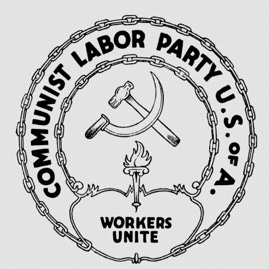
During World War I the government conscripted public opinion and demanded absolute loyalty. Every American was to become a super-patriot and self-styled spy-chaser using “Americanism” to retaliate against people whose opinions they hated and feared. After the war this “Americanism” turned against the Left. Loyal citizens made little distinction between Germans, anarchists, pacifists, Socialists, and Communists; most Americans considered anyone ideologically different from themselves a Leftist.
Near the end of the war, this attitude turned educational systems into battlefields. Teachers in certain areas were forced from their jobs for making allegedly unpatriotic statements to their classes. Historian Sidney Howard placed the situation in a nutshell: “Like all good patriots, they (were) simply hell on schools.” In some states the teaching of German was outlawed from public schools because of its subversive influence. After the war the teachers were compelled to reconcile their opinions with those of the school’s administration. Trials of teachers for disloyalty were most numerous in the city of New York, where discussions of the labor question, Socialism, the direct primary, the League of Nations, and other “controversial subjects” were out of place in school history.
In self-defense, towns and individuals with German names appealed to the courts, and Schmidts became Smiths and Berlins became Bellevilles. In some states men were tarred and feathered for failing to buy War Bonds, or to support Red Cross drives. Incidents such as these were common in this confusing, intolerant, and irresponsible atmosphere. In spite of the nation’s desire for a rapid return to peace, it was obvious that the American public of 1919 was still thinking like people at war.
This phenomenon stemmed from various events growing out of the Bolshevik revolution of 1917. Patriotic societies, such as the National Security League and the American Defense Society, consistently denounced the Bolsheviks as a counterpart of the dreaded Germans. The press circulated much exaggerated information about the Communist reign in Russia. As a result most Americans considered the Bolsheviks the epitome of all evil.
This group of Bolsheviks and Communists constituted a very narrow minority in the United States – absurdly narrow when all the to-do that was made about them is considered. In fact, this group numbered at most .2% of the total population in the United States. However, there was an unmistakable trend toward socialist ideas among liberal intellectuals, Roosevelt progressives, and laborites who advocated nationalization of industry.
These leftists were held responsible for a series of events beginning on April 29, 1919. On that day a bomb “big enough to blow out the entire side of the City-County building” was found in the mail of Ole Hanson, the mayor of Seattle. It is interesting to note that Mr. Hanson had made several attempts to arouse public opinion against the Red Menace. The following afternoon a colored servant[8] opened a package addressed to Senator Thomas R. Hardwick at his home in Atlanta, Georgia. A bomb in the package blew off her hands. Senator Hardwick, Chairman of the Senate Immigration Committee, had proposed immigration control as a means of keeping out Bolshevism.
Reading about the bomb explosion in Hardwick’s home, a postal clerk returned to the New York Post Office and found sixteen brown-paper packages neatly laid away on a shelf. The clerk had put them there because of insufficient postage. The bombs in the Post Office were addressed to Justice Holmes of the Supreme Court, Attorney General Palmer, Secretary of Labor Wilson, J.P. Morgan, John D. Rockefeller and other government officials and prominent capitalists. None of the remaining packages were opened carelessly; for the next few days people in high positions were very cautious about undoing brown-paper packages. The list of intended recipients was evidence sufficient to convince the public that the bombs were sent by an alien radical.
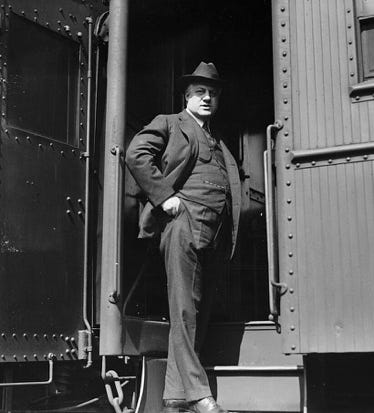
A month later there was a series of bomb explosions, the most successful of which damaged the home of Attorney General A. Mitchell Palmer in Washington, D.C.
The American public read about the bombs and savagely resolved to get back at “these radicals”. How they sought revenge is exemplified by two incidents which took place on May Day of 1919. In New York City, the staff of a Socialist newspaper was celebrating the opening of a new office. There were hundreds of men, women and children in attendance. A mob of soldiers and sailors stormed in, smashed up the offices, drove the crowd into the street and clubbed them vigorously. Elsewhere in New York City mobs broke up every radical gathering[9] but one – and 1700 club-swinging police were needed to prevent an invasion of this mass meeting in Madison Square Garden.
In Cleveland on the same day, there was a Socialist parade headed by a red flag. An Army lieutenant demanded that the flag be lowered. When he was refused, a group of soldiers leaped into the ranks of the procession and started a free-for-all. In another part of town, army tanks and trucks joined police and civilians in attacking an assembly of twenty thousand (who were) listening to speeches in the public square. A series of riots began which resulted in the deaths of two men and the wounding of a hundred.
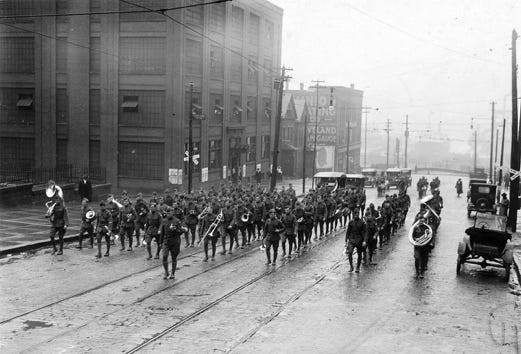
To avenge the May Day Riots a group of radicals shot down and killed six Armistice Day paraders in the streets of Centralia, Washington. This in turn encouraged citizens to seize a radical from the local jail and lynch him by tying a rope around his neck and throwing him off a bridge. For many Americans the May Day Riots provided evidence both of the strength of American radicalism and of the radical’s willingness to use force to achieve their ends.
While these riots were taking place, events which would prolong the Red Scare were developing. The Labor movement during World War I had gained momentum. There were hundreds of impending strikes induced by the war’s inflated prices and the unions’ realization of power. The government, under the hesitant leadership of President Wilson, encouraged collective bargaining and promised new benefits with the coming of peace. Peace came and Wilson did nothing. In response to low wages, rising prices, long (work) hours, and Wilson’s ignoring the problem, the unions used their only weapon – the strike.
The fear of the Red Menace was progressively receding from the May Day high until rejuvenated by the events of September, 1919. At this time the Boston police force, out of financial need, formed a union and on September 9 walked out during the evening roll call.
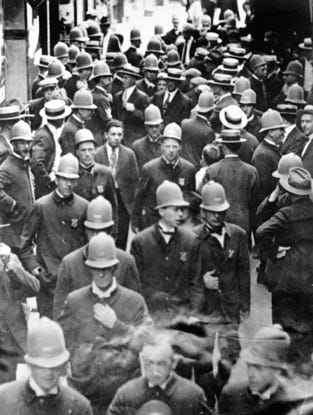
With the city left defenseless, hoodlums smashed windows and looted stores. The next day Governor Calvin Coolidge call out the State Guard, and a volunteer police force tried to control the situation. The volunteer police were inexperienced: they were goaded into firing on a mob in South Boston and killing two people. For days there was intermittent violence. The casualty list grew and the country watched with dismay. “Perhaps,” the people thought, “the dreaded revolution is beginning here and now.”
Public opinion in Boston and across the nation turned against the police and their cause was lost. Later Governor Coolidge publicly announced that there was “no right to strike against the public safety by anybody, anywhere, anytime”. Overnight he became a national hero. If there was any hope for the policemen’s strike, it vanished when the nation applauded Calvin Coolidge.
* * * * * *
This is a good place to interrupt my article. The rest of it will be posted next week.
Opa
[1] The information for this article was predominantly drawn from two books: Robert Murray’s Red Scare: A Study in National Hysteria (University of Minnesota Press, 1955) and Stanley Coben’s A. Mitchell Palmer: Politician (Columbia University Press, 1963). This paper was written 25 years before the internet was first available to assist in research and 55 years before AI became a useful tool.
[2] When I wrote about “faith and reason”, Gram wondered whether I was speaking about religious faith or about faith in government. I believe that either type has a role in determining how society responds to crisis, but as a teenager I was referring to faith in government.
[3] The Know-Nothing Party started as a secret fraternal organization called the Order of the Star Spangled Banner. Its name comes from denial by members when asked about their beliefs and activities. (“I know nothing!”) It was later called the Native American Party, and by the mid-1850s when its popularity peaked, the American Party. It was an anti-immigrant political movement, which favored native-born Protestant citizens over foreign-born newcomers, especially Catholic immigrants from Germany and Ireland. They demanded that all public offices be held by native-born citizens. In an August 4, 1855, letter to Joshua Speed, Abraham Lincoln wrote: “our progress in degeneracy appears to me to be pretty rapid. As a nation, we began by declaring that ‘all men are created equal’. We now practically read it ‘all men are created equal, except negroes’. When the Know-Nothings get control, it will read ‘all men are created equal, except negroes, and foreigners, and catholics’.” https://www.nps.gov/liho/learn/historyculture/knownothingparty.htm
[4] Led by Senator Joseph McCarthy of Wisconsin, an increasingly focal and influential group of leaders created fear of subversive Communist influence in their lives – especially by school teachers and college professors, labor organizers, journalists, and actors or artists. Between 1950 and 1954, during the Eisenhower administration, McCarthy held high profile Congressional hearings and public denunciations which created a climate of suspicion and fear across the country. https://millercenter.org/the-presidency/educational-resources/age-of-eisenhower/mcarthyism-red-scare
[5] Reconversion is the process of changing something back to a previous state. In this context, it refers to shifting the economy back to a peacetime one and the society back to a stable one.
[6] Inflation related to World War I was the worst the United States has seen. Prices increased 23.7% between June 1919 and June 1920. https://www.history.com/articles/inflation-prices-economy-wars-pandemic
[7] A dislocation of society refers to the breakdown of normal social life, with loss of shared rules, cultural roots, and community bonds.
[8] “Colored” was an acceptable term for people of African descent in the United States from the time after the Civil War until the 1960s, when the civil rights era began. It was initially chosen by Black Americans as a term of self-determination and dignity. The term is preserved in legacy institutions like the NAACP (National Association for the Advancement of Colored People), which is the oldest and largest civil rights organization in the United States.
[9] I should have written “every gathering deemed to be radical by politicians or agitators”.
[10] https://encyclopedia.1914-1918-online.net/article/mcadoo-william-gibbs/
[11] https://www.bpstrike1919.org/about-the-1919-boston-police-strike/
Fascinating and relevant for our world today…