
Red Scare Redux - Part 2
Letter #129

The first half of the article that I wrote in college about the Great Red Scare was the substance of last week’s Letter from Opa. It covered the origins of this uniquely American phenomenon, which began after the conclusion of World War I and during the third wave of the “Spanish Flu” pandemic, which affected a third of the world’s population and killed about 675,000 people in the United States.[1] Gram’s family was affected too: her maternal grandmother lost her first husband to this flu, as well as their three children: twins Peter and Paul, and Mary. Around the same time, Gram’s maternal grandfather (her grandmother’s second husband) left Russia (now Belarus) and came to America, taking a job as a coal miner in Pennsylvania.
In the United States unemployment was high, inflation was high, wages were low, and the economy was stagnant. American citizens were aware of the recent Russian Revolution, which had overthrown Tsar Nicholas II, as well the subsequent Civil War between the Reds and the Whites. In late 1919, the anti-communist Russian White Armies, which received support by soldiers from the United States, England, France and Japan, were being defeated by the Bolshevik Red Armies.[2]
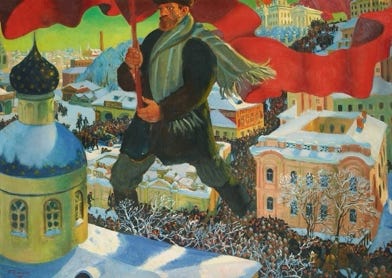
Back in the United States, some government leaders and politicians insisted that specific groups of American citizens should be blamed for emerging problems within the U.S., and blue-collar labor union members – with a desire to organize against their corporate leaders – were one of those groups. In this last half of my article “The Great Red Scare”, I continue with the story of what “organized labor” in America was doing in late 1919 after the failed police strike in Boston:
* * * * * * * * * *
At this time, however, organized labor was in a striking mood. A few days later several hundred thousand steel workers (across the country) walked out of the mills. There was little radicalism among these strikers who protested low wages and long hours. But the public was sensitized and would condemn any cause on which the Bolshevik label could be pinned.[3]
The steel strike had been in progress only a few weeks when a coal strike impended. In this case nobody needed to tell the American public of the Red Menace lurking behind the striking miners. The miners had already pinned the Bolshevik label on themselves by enthusiastically voting for nationalization of the mines. To the undiscriminating newspaper reader, public control of the mining industry was the same as Communism, anarchy, and bomb-throwing. In reply to the coal miners’ claims that their rights were being violated by the government,[4] the Department of Justice avoided the issue and raised a Red Scare.
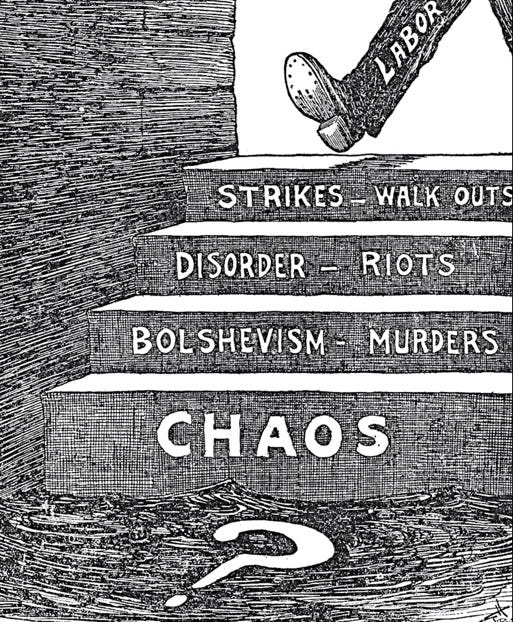
The press immediately came to their aid with headlines like: REDS PLANNING TO OVERTHROW AMERICAN GOVERNMENT. (Such a headline was based on an uncirculated circular published by a non-existent radical organization.) This was only the beginning of cooperation between the press and government bureaus in “redbaiting.”
Attorney General A. Mitchell Palmer saw the strikes as a new threat to the United States; the “Fighting Quaker” saw this as his opportunity to come to the rescue of the Constitution. On the day before the coal strike was due to begin, he secured from a Federal Judge in Indianapolis an order restricting the leaders of the strike from doing anything whatever to further it. Once Palmer had secured this injunction, the coal strike was doomed. Despite this, four hundred thousand coal miners walked out of the mines. The press across the nation applauded Palmer’s actions and the Fighting Quaker took heart.
Palmer’s next move was to direct a series of raids against the Communists of the nation. Under the Extreme Sedition Act used during the war, the Secretary of Labor had the power to deport aliens who were affiliated with any organization that advocated the overthrow of the government.[6] Attorney General Palmer now decided to “cooperate” with the Secretary of Labor by rounding up the aliens for mass deportation.
On New Year’s Day, 1920, in cities all over the United States, Mr. Palmer’s agents and police fell upon the Communists in their homes and meetings. Over six thousand were arrested in all. They were thrown behind bars for weeks, often without knowing the charge against them. Girls of 14, 15 and 16 years of age were arrested in various places as criminal anarchists. In Detroit three hundred people were arrested, held for a week in jail and denied food, only to be found innocent of any involvement in revolutionary movements. In Hartford, Connecticut, the authorities arrested all visitors who came to see suspects in jail. A friendly visit was regarded as evidence of membership in the Communist Party. In his statement immediately following the raid, Mr. Palmer attempted to justify his actions: “How the Department of Justice discovered these organized agitators is the confidential information upon which the Government is now sweeping the nation clean of such alien filth.”
Although the steel strike was failing, although the coal strike was failing, and although any danger of a revolution was fading, the great masses feared the Red Menace more than ever. After the Palmer raids the hunt for radicals went on. In April the five Socialist members of the New York State Assembly were expelled when one assemblyman said: “These men who sit there . . . are just as much representatives of the Russian Soviet Government as if they were Lenin and Trotsky themselves.”
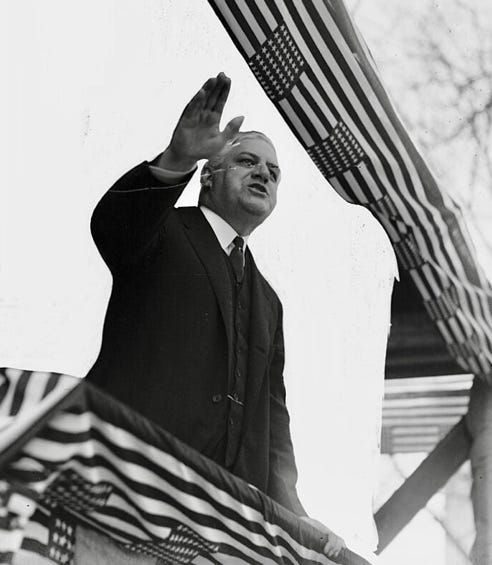
Attorney General Palmer resumed his attack on the Bolshevik movement when he promised a first-class Red Revolution for May Day, 1920. During this revolution the American Bolsheviks would attempt to “Plant the Red flag on the Capitol in Washington,” after murdering all prominent officeholders.[7] Inevitably May Day came and not a shot was fired, nor was blood shed anywhere. For the first time in his career, A. Mitchell Palmer cried “wolf” once too often, and he was greeted with laughter and derision.
The results of the Palmer raids were varied. After the January raids the membership of the Communist Party dropped from 30,000 to 2,000. The first shock of the raids was almost disastrous. Then came a gradual recovery to a point about one-quarter of the pre-raid average.
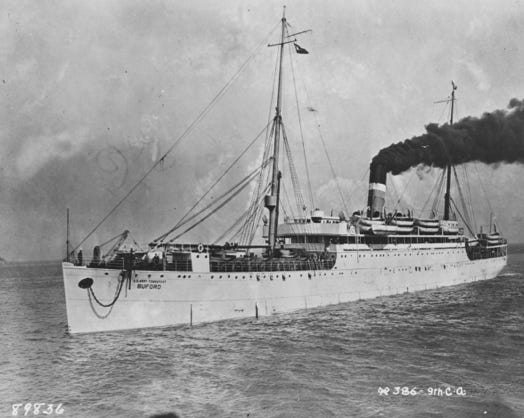
The high point of the anti-alien drive was the deportation of 249 aliens to Finland aboard the U.S.S. Buford, the “Soviet Ark”.[8] The two most famous passengers on the Buford were anarchists Emma Goldman and Alexander Berkman. By striking at these aliens, the Burford deportations struck indirectly at the Communist Party whose members were, in many cases, aliens.
Ironically, the Palmer raids also strengthened the Communist movement in the United States. The developing schism between the Communist Party and the Communist Labor Party was immediately repaired when both were confronted with the same repression. The raids came as a blessing to those who advocated revolution. More than ever they were able to imagine themselves as Russian Bolsheviks in America. They drew parallels between their underground activities and those preceding the revolution in Russia. They believed that if the Russian road to revolution was right, then the post-war repression in the United States merely offered additional proof that the American revolution was near.
As Communism declined in America and Palmer’s blunders increased, the country began to regain its senses. Strikes and riots continued, but with the coming of the summer of 1920, there were other things to compete for the attention of the country – the Presidential campaign, the revolt against high prices, the Overalls parade,[9] the “get-rich-quick” schemes, women’s suffrage, and prohibition.
The fact that the Great Red Scare was diminishing by the end of 1920 was shown when the nation managed to retain control when a real disaster took place on the 16th of September. The setting was Wall Street – the financial center of the country, the home of the New York Stock Exchange, and the offices of J.P. Morgan. At this precise spot, a moment before noon, a huge bomb went off. It went off with such appalling violence that it immediately killed thirty people and injured hundreds, wrecked the interior of the Morgan offices, and smashed windows for blocks around.
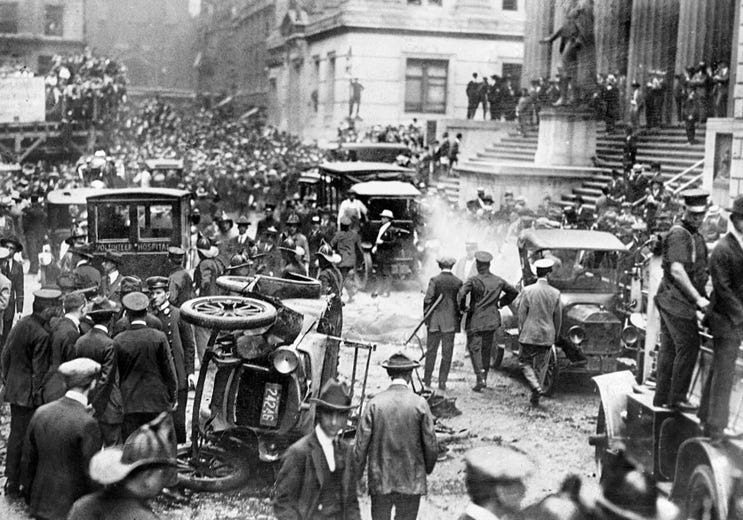
The radical’s bomb failed to serve its purpose – the victims of the explosion were not the financial powers of the country, but bank clerks and stenographers. After years of fruitless investigation, there was still a question of Red influence in the minds of those who tried to solve the mystery. The country followed the early stages of the investigation with absorbed interest. Yet no marked increase in anti-Bolshevik riots took place.
If the explosion had occurred a few months earlier, it might have had indirect consequences as violent as the damage which it did directly. But by this time the American people were coming to their senses and realized that no such insane and frightful plot could ever command the support of more than a handful of fanatics.
This was the Great Red Scare, a phenomenon of American history occurring in a time when the American people seriously thought that a Red Revolution might begin the next month or the next week, a time when citizens were less concerned with making the world safe for democracy than with making America safe for themselves, a time when America’s soul was in danger because its principles of freedom and tolerance had been deserted.
* * * * * * * * * *
My published article ends here. But for a postscript, I’d like to close with what Louis Post, Assistant Secretary of Labor, wrote at the end of his 328-page report entitled Deportations Delirium of 1920: “The episode might be safely forgotten were it not that it may serve as a warning to the American people to be alert, even in delirious periods, for the protection of American liberties. Lawless persecutions of resident aliens, though only symptoms of a popular frenzy, might easily lead on, if the delirium persisted, to comprehensive policies that would turn our Republic backward upon its democratic course. Americans cannot afford to ignore their traditional admonition that ‘eternal vigilance is the price of liberty.’”
Opa
[1] See: https://my.clevelandclinic.org/health/diseases/21777-spanish-flu and information which is archived from the CDC: https://archive.cdc.gov/www_cdc_gov/flu/pandemic-resources/1918-commemoration/1918-pandemic-history.htm
[2] And https://armyhistory.org/the-american-intervention-in-north-russia-1918-1919/
[3] https://www.history.com/articles/steel-strike-of-1919-defeat
[4] https://energyhistory.yale.edu/coal-mining-and-labor-conflict/
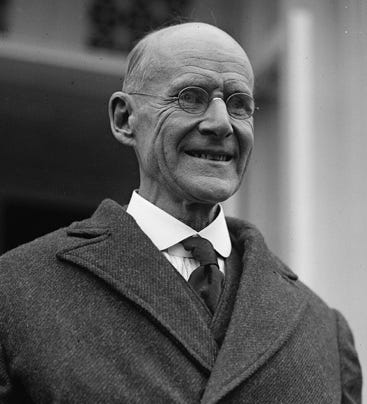
[5] https://aflcio.org/about/history/labor-history-people/eugene-debs
[6] The Sedition Act of 1918 expanded restrictions on speech and press, targeting any expression perceived as disloyal or unpatriotic, such as speaking against the government, military or flag. It also granted the Postmaster General to withhold mail that was perceived as being disloyal or unpatriotic, further suppressing dissent. https://www.ebsco.com/research-starters/military-history-and-science/analysis-sedition-act-1918
[8] A detailed account of the campaign to round up and deport aliens is available online at https://bit.ly/4bnTY75 . Entitled Deportations Delirium of 1920: A Personal Narrative of an Historic Official Experience, it was authored by Louis Post, Assistant Secretary of Labor from 1913 to 1921. An interesting exchange between Attorney General Palmer and Department of Labor conferee Warner Parker is recorded on pp. 56-57. The Attorney General disputed existing law, saying “Do you mean to tell me that there is no law under which you can issue a warrant for the arrest of an alien when I certify that he is subject to deportation?” Mr. Parker responded: “Mr. Attorney General, not only is there NO such law, but no such law would be Constitutional if there were one.”
[9] In the Overalls Parade of April 24, 1920, people in New York City and other cities wore denim work clothes to protest high clothing prices and wartime profiteering. https://www.gothamcenter.org/blog/the-new-york-city-overalls-parade-1920