
The Quiet Mind
Letter #109

Gram recently came home after attending an author’s reading at the downtown branch of the County Library. She was enthusiastic about her visit there, but she was also excited to bring home for me a book, which was among those stacked on the “Free Books” cart. I have to admit that, at first, when I thumbed through the book, I didn’t know exactly what to make of it. Later I will talk more about this book, which in some ways seemed over my head, but my eye was drawn to a very brief bit of verse on page 112. The language is somewhat dated, so I will indicate the rhythm of this iambic meter to provide a little clarity:
	When all is done and said,
	In the end thus shall you find:
	He most of all does bathe in bliss
	That hath a qui-et mind.
There was a simple footnote that attributed this quatrain to “Thomas, Lord Vaux”. I had no idea who Thomas Vaux was.
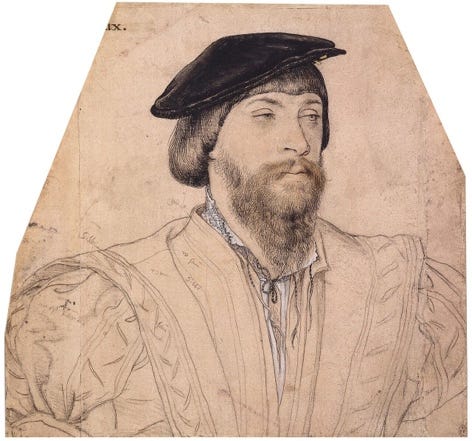
I found that there was more to his poem, which is entitled “A Quiet Mind”, or sometimes “A Contented Mind”.[2] Here are half of the remaining stanzas, the style of which reflects his apparent desire to share his wisdom with the common people of his time:
        And, clear from worldly care,
	To deem can be content,
	The sweetest time in all his life
	In thinking to be spent.

        Companion none is like
	Unto the mind alone;
	For many have been harmed by speech,
	Through thinking few or none.

	Fear oftentimes restraineth words,
	But makes not thought to cease;
	And he speaks best, that hath the skill
	When for to hold his peace.
Personally, I did not find this to be a particularly great poem, but I believe that it conveys an important message. It also has an interesting backstory. Five hundred years ago, Thomas Vaux was about to turn 16 years old. At that time, he would have been married for almost two years to Elizabeth Cheney, who was perhaps a few years older and to whom he had been betrothed since age 2. Thomas’ father died when he was 14, so by the time of his marriage he had become the 2nd Baron of Harrowden.
Four days before Thomas was born in 1509, Henry VIII became King of England at age 17 and the second monarch in the Tudor dynasty.[3] Within days of his coronation, Henry arrested and later executed two senior government ministers from his father’s court, demonstrating how he would continue to deal with those who interfered with his plans. Two months later, Henry married 23-year-old Catherine of Aragon – a member of Spain’s royal family – who had previously been married to Arthur, Henry’s older brother and first in line for the throne. Arthur, however, had died at age 15, just 5 months after his marriage to Catherine.
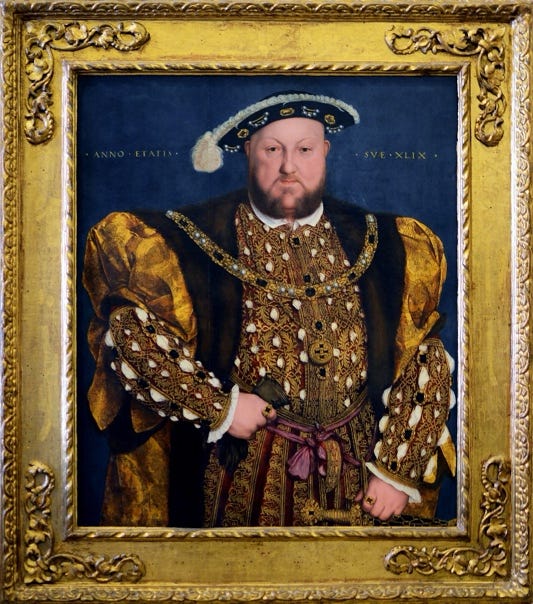
Thomas, Lord Vaux, by virtue of his family connections, became part of the Tudor Court. Thomas was a devout Catholic, as was Henry VIII until his Queen failed to provide him with a male heir. Henry became determined to marry someone who would. Thomas was prudent enough not to speak of his opposition to Henry’s desire to divorce Catherine of Aragon, although he privately abhorred the thought of this, especially after Thomas Wolsey, the Lord Chancellor of England, lost Henry’s favor when he could not persuade the Pope to annul Henry’s marriage.
After Thomas took his seat in the House of Lords, he accompanied Henry VIII and Anne Boleyn to Calais, France, where Henry met with King Francis I and introduced Anne as his consort.[4]. Henry and Anne were married after Anne became pregnant and before Henry’s marriage with Catherine was annulled. Catherine was subsequently executed, having given birth to a daughter, who – ironically– would later rule England as Queen Elizabeth I. It was at Anne Boleyn’s coronation as Queen in 1533 that Henry made Thomas an elite “Knight of the Bath” and Governor of the Isle of Jersey, the largest and southernmost of England’s Channel Islands.
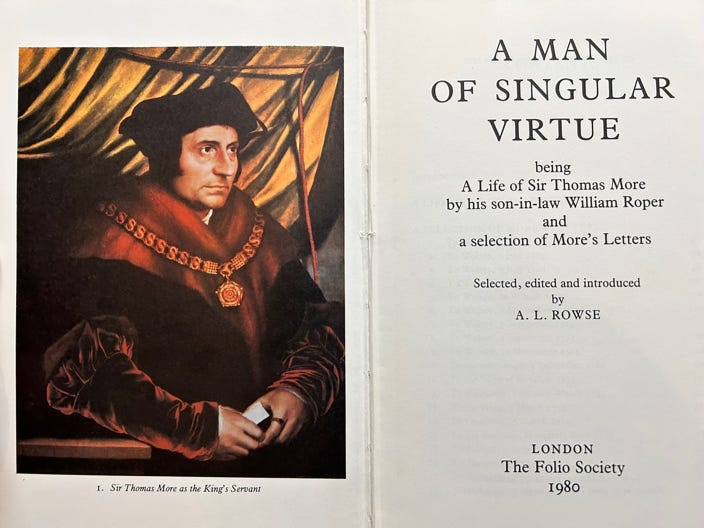
These were incredibly turbulent times. In 1521 Henry VIII had been given the title of Defender of the Faith by Pope Leo X. But within the next 15 years, he repudiated the authority of the Roman Catholic Church, appropriated for the English Crown all taxes and tithes previously paid by churches to Rome, dissolved and sold the assets of many monasteries – increasing his treasury by 1.5 million pounds – and created the new Church of England appointing himself as Supreme Head.[5],[6] During his reign, Henry VIII beheaded over 50,000 people, including two wives, Lord Chancellor Thomas Moore and Chief Minister Thomas Cromwell.[7]
Thomas Vaux experienced a rapid rise to prominence in the Tudor Court. He also witnessed the fall of many individuals greater than himself. He saw that life was intrinsically unstable, and that happiness came not from wealth or honor but with freedom from “worldly cares” and in pursuit of a “well-formed mind” linked to reason and virtue. In 1536, he resigned from his position governing the Isle of Jersey, and he retreated from the Tudor Court to his family estate, where he and his wife quietly raised two sons and two daughters.
He achieved some notoriety as an early Tudor poet at the beginning of the English Renaissance. Like other poets of this movement, his focus was on inner stillness – not as a compensatory good, but as the highest good or “bliss”. Furthermore, as a conservative Catholic struggling to practice his faith during the rise of Protestantism, he chose distance from rather than proximity to power and the cultivation of a well-ordered mind rather than royal favor.
You might ask why I focused on this verse when perusing the book that Gram brought home for me. When I found this stanza near the middle of the book at the end of a chapter called “Emptiness”, it seemed to be one of the few parts of these collected essays by D. T. Suzuki that I could understand. These essays were written in the 1930’s, 40’s, 50’s, and published in 1968 with the title On Indian Mahayana Buddhism. I would have had no interest in reading these essays at the time they were published – unless it was required reading in high school. However, almost 60 years later, his name has an eye-opening relevance.
Daisetsu Teitaro Suzuki died at age 96, two years before the book’s publication. Suzuki was a Japanese scholar who wrote about spiritual transformation, but he lived and taught as an ambassador of Eastern philosophy and religion to Western civilization. For much of the 20th Century, Suzuki was the most popular interpreter of East Asian culture.[8] He mentored individuals such as the psychiatrist Carl Jung, the philosopher Martin Heidegger, and the Christian mystic Thomas Merton. He was an inspiration for the poet Allen Ginsberg.
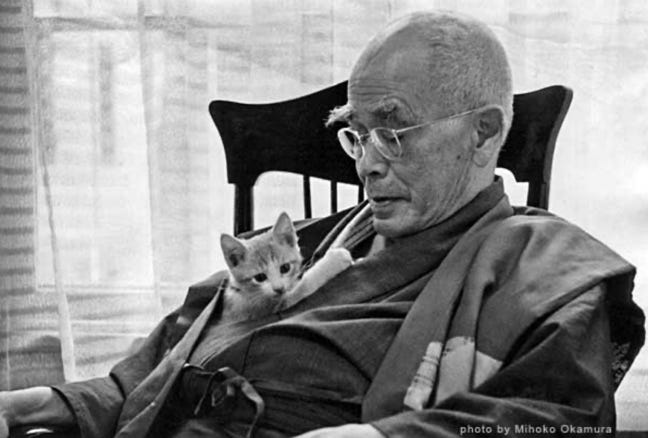
My understanding of what Suzuki describes as “emptiness” is a state free of judgments, biases, pre-conceived notions, distinctions, and dualisms such as good versus bad or being versus non-being. This is what has come to be known as the Zen life. He writes, “It is indeed owing to this Emptiness as the ground of existence that our universe is at all possible with its logic, ethics, philosophy and religion.” I think I now understand why Suzuki valued Vaux’s poem “A Quiet Mind”.
In the Buddhist tradition, this Emptiness is intuitive and the way to awaken thoughts without allowing them to abide anywhere. In the Christian tradition, Suzuki says this Emptiness is God himself – the ground of all things. He quotes extensively from the Theologia Germanica, a late 14th Century treatise by an anonymous “Friend of God”, which was re-discovered and then published by Martin Luther in 1516. Luther was profoundly influenced by the treatise’s stress on abandoning selfishness and self-will, transforming the inner spirit, and aligning the soul with God.[10]
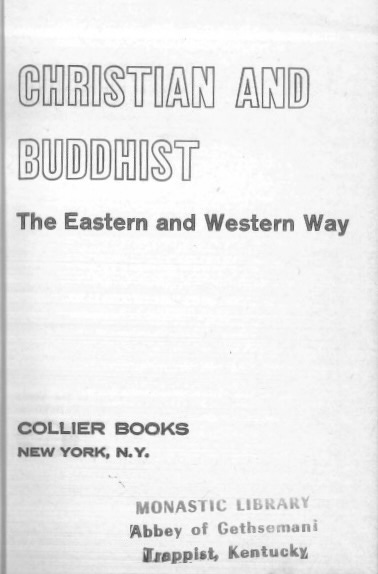
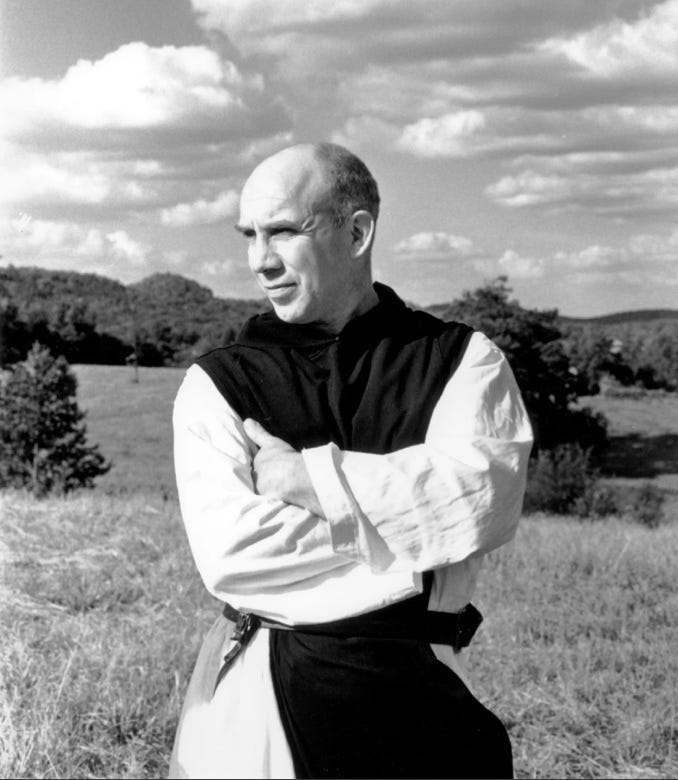
In my lifetime, a bridge of understanding between Buddhism and Christianity was strengthened by Thomas Merton, a Trappist monk who lived in the Abbey of Our Lady of Gethsemani in Kentucky.[11] He saw “resonance” between the early Christian Desert Fathers and the Zen Buddhists, who both sought a loss of self and a merger into a larger reality. Each learned to experience themselves as a riddle without easy solutions. And Merton reflected on the enigmatic statement by John of the Cross that God is “everything and nothing at once”,[12] as well as Jacob Boehme’s comment that those seeking God find Nothing (though it is God himself), as He is both inconceivable and inexpressible.[13] Ironically, a book by Suzuki entitled Mysticism: Christian and Buddhist: The Eastern and Western Way[14] resides in the Abbey of Gethsemani’s library:
Thomas Merton’s final book (published posthumously in the same year as Suzuki’s book) was Zen and the Birds of Appetite. “Birds” were his metaphor for restless, consumerist human desires that disrupt our inner peace. For him, the Zen approach to Christian meditation offered a path beyond a possessive “scavenger” mindset towards deeper spiritual awareness.
What impresses me is the desire by many people – across centuries and cultures – to free our minds from the busyness, biases and clutter of our daily thoughts and focus on deeper insights into the nature of God in the nothingness and everything-ness of the universe around us. This could have been the epiphany for St. Thomas Aquinas when, in December, 1273, he had a profound mystical experience that led him to abandon writing his majestic Summa Theologiae, saying that his writings were insignificant and appeared to him as no more than “straw”. [15]
In our journey through life, whether or not we experience mystical moments or profound insights, let us at least strive to develop a “quiet mind” that is free from bombardment by unnecessary details and concerns that will ultimately pass and to make room for understanding and wisdom that will endure. Our actions will reflect either the chaos or the equanimity of our minds, and those actions will be revealed in how we live, interact with others, and pursue the unknowable and the knowable.
Opa
[2] The entire poem can be found at https://www.poemhunter.com/poem/a-quiet-mind-4/
[3] https://ornc.org/our-history/greenwich-palace/the-tudors/
[4] https://www.theanneboleynfiles.com/14-november-1532-the-marriage-of-henry-viii-and-anne-boleyn/
[6] https://www.historic-uk.com/HistoryUK/HistoryofEngland/Dissolution-of-the-Monasteries/
[7] https://history.howstuffworks.com/historical-figures/10-henry-viii-executions.htm
[8] https://www.asianstudies.org/publications/eaa/archives/d-t-suzuki-a-biographical-summary/
[9] The film is reviewed at https://kyotojournal.org/reviews/a-zen-life-d-t-suzuki/ and is available to view on Amazon Prime.
[10] An English translation can be found at: https://www.ntslibrary.com/PDF%20Books/Theologia%20Germanica.pdf
[11] https://www.americamagazine.org/faith/2012/07/13/thomas-merton-and-dialogue-buddhism/
[12] https://en.wikipedia.org/wiki/John_of_the_Cross
[13] https://en.wikipedia.org/wiki/Jakob_Böhme
[14] A full digital version is available at: https://sacred-texts.com/bud/mcb/index.htm
[15] https://scriptoriumdaily.com/thomas-aquinas-big-pile-of-straw/