
Time Travel - Part 2
Letter #118

Thinking further about my conversations with former classmates at our medical school reunion, I would say that we remember Dr. Philip Tumulty as one of the most beloved. Many classmates spoke fondly about this energetic, bespectacled, white-haired, red-cheeked master diagnostician who was known at Hopkins as the “doctor’s doctor”.[1] A half-century before artificial intelligence (AI) became a useful tool for clinicians, he had an uncanny ability to assemble a variety of clinical clues into amazingly useful diagnostic probabilities.
In fact, throughout the history of medical education at Johns Hopkins, and a few years past our graduation, the hospital hosted a weekly conference known as the CPC, or clinical-pathological conference, which was designed to refine our diagnostic skills. This was held at noon on Wednesdays in Hurd Hall, a steeply tiered auditorium; everyone had an unobstructed view of what was taking place down front.[2] A patient case was presented – with all clinical, laboratory and imaging details. First, the medical students – as a group – were queried to talk about what we thought was the patient’s problem. Then, the residents were asked what they thought. Then the faculty in attendance were asked to discuss their impressions.
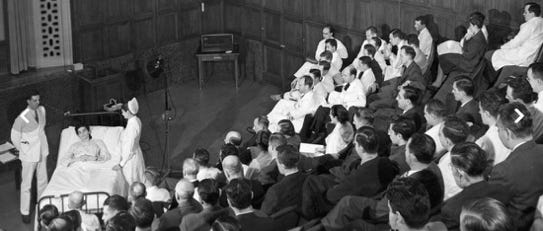
Next, a pre-selected senior faculty member who did NOT have prior knowledge the patient’s diagnosis or outcome, stood at the lectern to give a detailed discussion about what he (or rarely, she) believed were the pertinent details and the proper thought process to reach the correct diagnosis. Finally, a pathologist who had access to the patient’s autopsy results or outcome, shared the “answer” that everyone was seeking. This weekly event was perhaps one of the best – if not the most solemn – of the educational traditions I experienced at the institution.
Because we attended school when many university students were questioning societal norms and disrupting rigid traditions, the CPC was perhaps the best place for making some sort of statement. All of us at the reunion recalled the day that a handful of our male classmates in the back of the auditorium - as the invited senior faculty member began to speak – took off the scrubs they were innocuously wearing and streaked (naked) down the steps to the front of the hall and then out the side doors. Many of the assembled were aghast! But Dick Johnson, a world-renowned virologist,[3] only paused and smiled, continuing his presentation unphased.
Streaking was a short-lived national phenomenon in the 1970’s, perhaps as much for fun as for making a statement during those turbulent times.[4] But it proved to illustrate the importance of clearly understanding human physiology, as the men who chose to participate wanted to make sure they wouldn’t have erections while running. Fortunately, erections are driven by the parasympathetic nervous system, and they were right in concluding that it was the sympathetic (“fight or flight”) nervous system that is activated when you are running naked through the CPC.
Several of us agreed that our favorite professor during the first year of medical school was Hendrik van der Loos, who taught our neuroanatomy class. The son of a minister and born in the Netherlands, he went to medical school in Amsterdam. He had remarkable drawing skills and his chalkboard anatomical illustrations were clear and compelling. At the end of each day, I replicated from my notes his colored drawings from the board. He was one of several outstanding faculty who strengthened my interest in neurology.
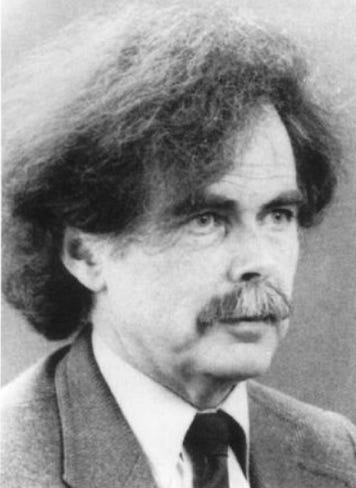
Dr. Van der Loos also had an extraordinary ability to weave a fascinating story. I remember one lecture that gradually morphed from instruction about cerebellar anatomy into a parable about the Vietnam War, which was then entering its eighth year. It was a gentle reminder to us that we should not forget the world around us as we immersed ourselves in the study of medicine. I have long wished that lectures were recorded or videotaped in those days, because I marveled at the elegance and enthusiasm with which he taught the organization of the brain with his own joie de vivre. As one of his colleagues wrote, “He characteristically spent every available minute in preparation for lectures, even on subjects he knew perfectly.”[5]
Another favorite professor of mine was Rafael Garcia-Buñuel, who inspired many of us to pursue Neurology. He came to Baltimore from Beth Israel Hospital and Harvard Medical School in Boston, to teach neuroscience and neuropathology, and he liked to think it was in the tradition of his famous countryman and Nobel Prize winner, Santiago Ramón y Cajal.[6] At the time of our instruction in the early 1970’s, Dr. Garcia-Buñuel was a clinical pathologist on staff at Baltimore City Hospitals, which was initially affiliated with Johns Hopkins and later absorbed into the Johns Hopkins Hospital / Bayview complex. A masterful storyteller and teacher, Dr. Garcia-Buñuel was the brother of the famous Spanish filmmaker, Luis Buñuel, whose movie The Discreet Charm of the Burgeoisie premiered during our first year of medical school.
At our graduation ceremony on May 21, 1976, when my classmates and I received our Doctor of Medicine degrees, we all felt particularly privileged that two individuals admired by many of us were also chosen to received honorary medical degrees. One recipient was Dr. Helen Taussig, the first pediatric cardiologist, whom I wrote about in Letter #75, A Heart for Children.
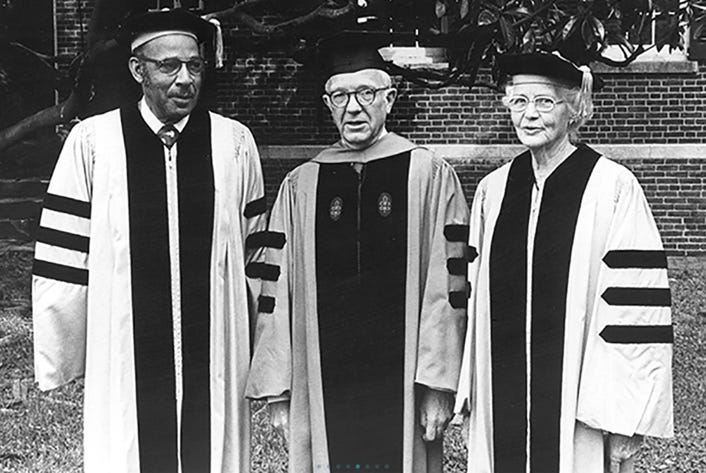
The other was Mr. Vivien Thomas, whose story was made more widely known through the 2004 HBO drama Something the Lord Made.[7] The medical world can hold some of its secrets and perpetuate some of its myths, but the truth becomes known to most who work within it and the secret of Vivien Thomas was certainly known to us as medical students. Three decades before we even started medical school, this gifted, African-American mechanic without a college degree became the research and surgical assistant whose intelligence and skill elevated his faculty employer to international fame.
Mr. Thomas developed the core technique and performed over 200 procedures on dogs before he coached Dr. Alfred Blalock in performing the first Blalock-Taussig shunt on a human infant with congenital heart disease. It was immensely gratifying for us to see Mr. Thomas, already 65 years old at the time of our graduation, be recognized for a lifetime of unprecedented achievement and to leave the stage as Dr. Vivien Thomas. This was a memory that many shared at our reunion.

There is a certain wry humor among medical professionals – whether doctors, nurses or other staff – that most people typically don’t understand or appreciate. I suppose it comes from our regular exposure to life-and-death issues, to patients at the most difficult times of their lives, to conditions that are exotic, poorly understood, untreatable, frightening, or just very sad. At the same time there is a degree of ruthlessness among medical professionals to humble the arrogant among us, in order to level out a hierarchy that often works against, rather than in pursuit of, broadening knowledge and developing collegial cooperation.
This was in part the impetus behind the Pithotomy Club,[8] which was started by the first graduating class of the Johns Hopkins Medical School in 1897 and continued until a few years after we graduated. It was designed as a place to “open” (otomos) “a keg” (pithos, or vessel) and to facilitate social interaction between students and faculty. At the end of each year, graduating medical students wrote a somewhat raucous, musical skit to satirize the perceived excesses of residents or faculty, while at the same time memorializing in song those who provided genuine support to them over the years.
Humor proved an effective way to communicate with our peers, too – even about mundane topics among roommates. In addition to preserving my medical diploma, I have also saved a certificate created by one of my roommates, Roy. It was an award from his fictitious American College of the Apocalypse, dated May 19, 1976. It is a Certificate of Merit for what should be understood as a GROSS exaggeration of my weaknesses as a roommate:
1)	Consuming his fair share of ice-cream, apple sauce and raisins, and ensuring that no one else’s fair share goes unconsumed;
2)	Driving a big new car, listening to $900 worth of stereo equipment, buying $96 worth of junk, claiming it to be “Art”, and at the same time pleading poverty and bankruptcy;
3)	Coasting during the past 18 months on his reputation as “Mr. Neat”, while at the same time dumping dirty dishes in the sink, leaving his insipid fascist Christian Science Monitors in the living room, dining room and kitchen, and leaving sticky, greasy PB&J and rice cracker crumbs on the dining room table after snack break every night;
4)	Forcing us to eat mucopurulent corn starch gravy on our dinners, and then sneaking upstairs for a midnight snack of purified gluten derivative;
5)	Receiving too much mail;
6)	Hoarding the only toilet paper in the house in his private bathroom; and
7)	Playing the Chopin Polonaise 496 times, and sounding no better on the last than on the first time around.
It was signed by two of my roommates, using their noms de guerre, “The First Apostle” and “The Great Northern Wonder”, and stamped with a brass gromet – the Great Seal of the College of the Apocalypse.

At the formal dinner ending our reunion celebration, I sat next to a classmate, Marty, whose wife was not able to attend the reunion. Marty was always erudite, but in my recollection he was somewhat quieter than many classmates. We had a great conversation amidst the hubbub of the dinner. I knew the university honored us because they served two entrees – filet mignon and crabcake (for Gram and me, gluten-free). As I thumbed through the colorful Commemorative Biographical Book that the school had prepared for our class, I commented to Marty about how tragic it was that we had already lost 15 of our classmates.
To my surprise, he responded that this was not a tragic number of deaths! As an MIT graduate who studied Applied Math, he interpreted this statistic much differently than I did. He explained how he had calculated the ratio of men and women in our class and the average life expectancy for Americans of both sexes, concluding that – demographically – we should have lost twice that many. “Of course,” he acknowledged, “doctors may constitute a special subset within the American population.” I had to laugh, reflecting on what an extraordinary group of people my classmates are.
I count it a privilege to have studied and learned alongside such remarkable people.
Opa
[1] https://pmc.ncbi.nlm.nih.gov/articles/PMC4624491/
[2] https://oac.med.jhmi.edu/cpc/index.html
[3] https://hub.jhu.edu/2015/11/25/richard-t-johnson-neurovirology-obit/
[4] https://en.wikipedia.org/wiki/Streaking
[5] Goldblatt, D. Pain–the other kind: Hendrik Van der Loos, 1929-1993, Seminars in Neurology 1994; 14(3),281-287.
[6] https://www.nobelprize.org/prizes/medicine/1906/cajal/biographical/
[7] The complete, dramatic biographical movie is one that everyone should see. It can be viewed at without charge at
[8] http://www.pithotomy.com/history.html. The demise of the club was precipitated by a faculty member who took offense to portrayal of her rapid rise to national fame (https://en.wikipedia.org/wiki/Bernadine_Healy).